Blog

developing ei (1)

Right Fit Leading: EI in the Workplace

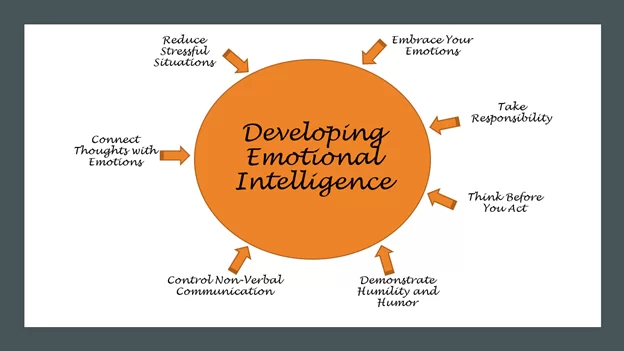
Emotional Intelligence (EI) is the ability to sense, understand, and effectively personal emotions and the emotions of those around you to get the best of human energy, information, trust, creativity, and influence. EI can deliver the following benefits: Embrace your emotions Take responsibility Think before you act Demonstrate humility and humor Control non-verbal communication Connect thoughts with emotions Reduce stressful situations EI is useful for career success, helping leaders and their staffs build a collaborative culture, emphasize everyone’s strengths, and work to mitigate weaknesses. EI is a method that can create strong bonds in teams by sharing technical expertise and creating solid recommendations for action. There are key components to EI in the workplace: self-awareness, self-regulation, social awareness or skill, empathy, and motivation. Self-awareness is the ability to know your emotions, strengths, weaknesses, and motivators and how they affect others. Self-regulation is the ability to manage personal emotional state and to think before acting. Social awareness or skill refers to proficiency in managing relationships, finding common ground, and building rapport. Empathy is about understanding and appreciate other people’s emotions, strengths, weaknesses, and motivators and use the knowledge to guide your behavior. Motivation is the passion and persistence that guides your efforts in reaching team goals. Two theories are helpful for those who embrace EI. Sensemaking Theory is a collaborative process that creates shared awareness and understanding out of different individuals’ perspectives and varied interests. Communication Accommodation Theory addresses adjusting verbal and nonverbal interactions to emphasize or minimize differences between participants. These interactions use language, context, identity, and intergroup and interpersonal factors to find common ground. There are many benefits to developing EI in the workplace beyond those listed here. I look forward to continuing the discovery.

Right Fit Leading: EI in the Workplace Read More »

people 2344401 340

Right Fit Leading: Trust, Train, and Communicate

I just read a telework article about how bosses don’t trust workers. Despite current statistics that say otherwise, the article said that most bosses think that workers are not as driven or committed as the office staff. COVID has shown instances where the driven workers are just as driven when they work from home; maybe more so. Leaders have the responsibility to trust, train, and communicate with their employees whether they are onsite or not. But to generalize people into driven and non-driven buckets is not fair. Everyone has some of both in them. The key to true leadership is partnering with people to show them how to be driven more often and to be lethargic less often. This has truly little to do with where they sit when they are in either condition. I argue that people can be driven while working from home. They do not have to come to the office to be high achievers. For instance, an article by an Upwork chief economist is useful in assessing the future of telework (Ozimek, 2020). The author analyzed what we already know; there was a forced movement to remote work generated by COVID-19. The study investigated the current state of remote work and drew conclusions about the long-term impacts. Upwork looked at a combined 1,500 hiring managers to get answers. Executives, vice presidents, and managers shared their views and plans that guided their remote work decisions. “One third of hiring managers found that productivity had increased as a result of remote work, a greater share than found productivity decreased (Ozimek, 2020, p. 2).” Finally, the Upwork study signals opportunity to convince more leaders to accept and support remote work. Upwork’s survey demonstrated that remote work had gone better than expected as reported by 56% of hiring managers. Only one in 10 reported remote work had gone worse than expected. It is interesting to note that the Upwork study demonstrates that despite many responses about why remote work worked poorly, there is optimism that productivity has increased and will continue to do so. Some of the problems reported in the survey were technological issues (36.2%), increased distractions at home (32.0%), reduced team cohesion (30.5%), difficulties in communication (30.3%), teams are less organized (23.3%), and less productivity (22.5%). Only 14.8% of respondents reported no issues. However, 32.2% of hiring managers reported an increase in productivity as opposed to only 22.5% who reported a decrease. The author states, “That one third finds remote work increases productivity, despite the rapid pace of change and struggles with technology, is a very optimistic result for future adoption and future productivity (Ozimek, 2020, p. 5).” The other thing I noticed while reading the telework article the other day is that one person who commented said that most people don’t work hard or have initiative. His comments also included that physical oversight is needed to get most people motivated when the boss can’t see them. While I disagree with this point of view, the person made one statement with which I concur. A tangible deliverable is needed to get results. My point is that people can do equally well meeting that tangible deliverable whether they are at home or at work, and whether they are in sight or out of sight of the boss. I can stall you just at well while you’re watching me as I can while you’re not. These are issues of trust and control. How much trust is present and how much control is exerted. A good working relationship can have trust between supervisors and employees, and tangible deliverables and accountability can mitigate or alleviate control issues. Leaders who think their employees don’t work hard or have initiative should look in the mirror and assess their leadership approach. Remember, you hired them and they are your responsibility to train, communicate with, and nurture. Ozimek, A. (2020). The future of remote work. Available at SSRN 3638597. https://papers.ssrn.com/sol3/papers.cfm?abstract_id=3638597

Right Fit Leading: Trust, Train, and Communicate Read More »

dsc 5449

Creator Spotlight with Writer Michael A. Brown Sr., Ph.D.

by Copyright Alliance This week we would like to introduce you to writer Michael A. Brown Sr., Ph.D. He’s the author of 3D COACHING: Suggestions for a New Approach. What was the inspiration behind becoming a creator? What do you enjoy most about the creative process? I always had a talent for writing, but when I became a journalist my writing just continued to improve. When I had jobs where I worked on deadline, I had to be creative in a pressure cooker and it helped me stretch my brain for different ways to say the same thing. The thing I enjoy most is taking a random thought and turning it into something meaningful or insightful. And I like to see my name when it is published in any forum. Can you take us through your creative process? How long does it take? Does everything you produce make money? My creative process is on all the time. If I think of something, I just capture it in my files and worry about where it belongs or what it will turn into later. The key is to get it down on paper, in the computer, on a scrap of paper, in my handheld recorder, etc. When I must write on deadline, such as when I wrote more than 40,000 words for a book in 10 days, I just write and get it all down, then I go back and edit and format. No, not everything I produce makes money. I want to make money but getting my work in print is more important, so I do not lose my thoughts. What do you think is the biggest misconception about your line of work? Some people think that if someone is critical of your writing you are not a good writer. Not true. Anyone who can put their thoughts together and deliver them in a package can learn to write well. How good you are is up to your audience, yes, but it is also up to you. Always, always ask yourself if the product is good and be honest with yourself. If YOU cannot say it is good, rewrite it. Then, your challenge is getting your writing into the hands and minds of the audience that can appreciate the work. When did you first become aware of copyright, and why? Since I have been a journalist and an author virtually all my life, I would say it was when I was a teenager.  What is the best piece of advice that you would give other creators in your field about copyright and how to protect themselves? Copyright your work through the U.S. Copyright Office. Pay the fees to protect yourself because what you write may be the most valuable thing you have. Are you one of our Individual Creator Members? Participate in our Creator Spotlight series! Please email us at cawebsite@copyrightalliance.org. And if you aren’t already a member of the Alliance, you can join today by completing our Individual Creator Members membership form!

Creator Spotlight with Writer Michael A. Brown Sr., Ph.D. Read More »

9 1

Right Fit Leading: Telework Requires Shared Values

Team members are consistently interested in making the adjustment to remote work and leaders continue to work to find shared success. The relevance for team members is accountability and the relevance for leaders is responsibility. Team members are accountable to do the work for which they are responsible. Leaders are responsible for setting processes and communication methods to empower member accountability. Everyone knows the telework plan must be created, and people must be educated, but shared understanding must be achieved. The path to success is interactive communications where both sides can demonstrate and discuss their understanding of the rules. Where there are disconnects, leaders must take the time to clarify and, when necessary, adjust or amplify the guidance. The table below demonstrates key issues in effective teleworking requirements. These issues are shared by leaders and team members, while each has a different connection to each factor. Effective Teleworking Requirements Shared understanding of policy Regular, purposeful connections Recognition and reporting One-on-one communication Adequate resources Specific communication preferences Consistent, efficient work routines Leaders and team members can work together to improve face-to-face opportunities, reduce social isolation, and manage distractions at home. The telework plan should be implemented so that there is a shared understanding with all parties, and it should set the stage for regular, purposeful connections to assist with performance. Leaders should provide acknowledgement and praise as necessary but should also make course corrections when necessary. Providing the resources necessary to conduct efficient telework operations and establishing team communication preferences are critical success requirements. Finally, a consistent routine is necessary to keeping everyone on the same page. Team members want to stay visible while teleworking and must learn the plan and follow it. Team members should participate in regular team connections and should look for every opportunity to have one-on-one communication, especially with their supervisor. Accountability is verified when accurately reporting performance or progress. Once team members work with the organization to identify resources necessary for teleworking that they may not be able to provide themselves, they must ensure they are fully responsible for the work they are charged with. They must adjust their personal situation at home to allow them to follow the organization’s stated routine or activity. Does this information help you in your personal telework situation?

Right Fit Leading: Telework Requires Shared Values Read More »

Call for Chapter Proposals: Interpersonal Dialogue and Human Communication

  CALL FOR CHAPTER PROPOSALS Returning to Interpersonal Dialogue and Understanding Human Communication in the Digital Age A book edited by Michael A. Brown Sr, PhD, Florida International University, and Leigh Nanney Hersey, Ph.D., University of Louisiana at Monroe     Introduction Human communication is struggling in what is a global crisis.  Society no longer fosters face-to-face interactions.  Compounded by the influence of the digital world, digitally-driven interactions in a multi-generation society have resulted in personal interactions that are fraught with limited feedback, erroneous and incomplete information leading to misunderstandings, even confrontations.  Digital collaborations are abundant, but can be problematic as an incomplete solution to the human need for comprehensive communication.  The 5,000 digital messages the average American receives daily lack full-process interactions from sender to receiver to feedback (see note). This creates communication based on missing information, gaps in communication, misinterpretation of language and other barriers.  Human communication distinguishes face-to-face communication as a priority over online or digital interactions.  This is not to downplay the electronic arena; just to highlight the connection between people that involves the five senses. High-touch, effective communication is about using social capital to build relationships and make information-sharing connections.  It is important to improve internal and external digital communications and to demonstrate ways to “positively affect productivity, levels of trust, and the ability to conduct bonding, bridging, and linking activities.”  High-touch activities lead to engagingly effective communication relationships with valuable feedback.  The book would address face-to-face interactions and digital collaboration, possibly in separate sections. NOTE: Sheree Johnson, New Research Sheds Light on Daily Ad Exposures, Sept. 29, 2014, https://sjinsights.net/2014/09/29/new-research-sheds-light-on-daily-ad-exposures/ .   Objective of the Book Dr. Brown’s previous work in Solutions for High-Touch Communication in a High-Tech World (IGI Global, March 2017) sets the stage for a full examination of human communication in today’s society by comparing online and face-to-face interactions.  This book takes advantage of that foundation and develops solutions for success in academia and in business by analyzing various types of face-to-face and digital interactions in terms of comprehension and relationship-building.  The integration of techniques for all human communication gives people resources to be successful collaborators in contemporary society.  This is an approach you won’t find in any one book today.   Recommended topics include, but are not limited to, the following: A global communication crisis?  Real or imagined? Data Gathering Relevant to the Challenge Unmediated and Mediated Interactions Face-to-Face Interactions Digital Collaboration Integrated Communication Focus on the Non-Digital Aspects of Communication in Society Communication: Interaction, Collaboration or Both? Communication, Evaluation and Comprehension Health and Communication Choosing the Right Platform for Communicating Developing relationships – face-to-face and online Making Communication Human – full-process communication with feedback Historical development of face-to-face vs online communication New research directions in human communication Evaluating social media communication Evaluating social media trust Comparing face-to-face and online communication methods, strengths, weaknesses Interactive communication Evaluating quantity vs quality in communication Trust and communication Trust and privacy Inter-organizational communication   Submission Procedure Researchers and practitioners are invited to submit on or before April 1, 2017, a chapter proposal of 1,000 to 2,000 words clearly explaining the mission and concerns of his or her proposed chapter. Submit your proposal at http://www.igi-global.com/publish/call-for-papers/call-details/2660. Authors will be notified by June 1, 2017 about the status of their proposals and sent chapter guidelines. Full chapters are expected to be submitted by August 1, 2017, and all interested authors must consult the guidelines for manuscript submissions at http://www.igi-global.com/publish/contributor-resources/before-you-write/ prior to submission. All submitted chapters will be reviewed on a double-blind review basis. Contributors may also be requested to serve as reviewers for this project. Note: There are no submission or acceptance fees for manuscripts submitted to this book publication, Returning to Interpersonal Dialogue and Understanding Human Communication in the Digital Age. All manuscripts are accepted based on a double-blind peer review editorial process. All proposals should be submitted through the E-Editorial DiscoveryTM online submission manager. Publisher This book is scheduled to be published by IGI Global (formerly Idea Group Inc.), an international academic publisher of the “Information Science Reference” (formerly Idea Group Reference), “Medical Information Science Reference,” “Business Science Reference,” and “Engineering Science Reference” imprints. IGI Global specializes in publishing reference books, scholarly journals, and electronic databases featuring academic research on a variety of innovative topic areas including, but not limited to, education, social science, medicine and healthcare, business and management, information science and technology, engineering, public administration, library and information science, media and communication studies, and environmental science. For additional information regarding the publisher, please visit www.igi-global.com. This publication is anticipated to be released in 2017. Important Dates April 1, 2017: Proposal Submission Deadline June 1, 2017: Notification of Acceptance August 1, 2017: Full Chapter Submission September 30, 2017: Review Results Returned November 15, 2017: Final Acceptance Notification November 30, 2017: Final Chapter Submission Inquiries can be forwarded to Michael A. Brown Sr, PhD Florida International University dr.michael.brown76@gmail.com (757) 876-6589 Leigh Nanney Hersey, PhD University of Louisiana at Monroe Hersey@ulm.edu (318) 342-1332  

Call for Chapter Proposals: Interpersonal Dialogue and Human Communication Read More »

Call for Chapters: Social Media Performance Evaluation and Success Measurements

As many organizations work to create social media policies that improve online interactions and provide security protections, performance is neglected.  Organizations do not tend to inquire about return on investment or performance implications until they are well into social networking activities.  This book demonstrates that using measurement tools facilitates success in social networking activities and in policy decisions.  This is important because it gives organizations tools with which they can impact online interactions as they happen.  Effective measurement can also suggest methods to affect behaviors that support the organization’s goals and objectives.  There are two major objectives.  First, help organizations identify social networking participation expectations, value and return on investment of time.  Second, highlight the true value of social networking, focusing on public administration to evaluate social networking and individual performance differences in participation, behavior, technology acceptance, and trust.  This is a new approach to social networking.  Issues in evaluating trust in social media, examining social networking participation in a different way, and addressing digital communication return on investment, all point to the need for an edited collection of original research in this area. This project is intended to provide researchers and academicians a new source for social networking methodology.  The scored survey instrument, research findings and relevant discussions from industry experts will be helpful in teaching and training applications.  The body of work focuses on the end state of social networking activities rather than the social media platform, an important distinction.  The basis of the book is a published dissertation by Dr. Michael A. Brown Sr.  SNIP doesn’t focus on “how to” use platforms, it’s about deciding on an end state and devising a strategic approach to arrive at that destination.  The focus is on expectation, value and return on investment of time in social networking, and the author believes there is no reference that focuses on that approach. The target audience of this book will be composed of professionals and researchers working in the various fields of public administration, and can be used to reinforce organizational training and improve internal and external communications. This work directly relates to the information and business fields in terms of communication; however, social networking and social media continue to grow in medical and engineering science, making the book relevant there as well. Further, there are implications for information and knowledge management in various disciplines, e.g. library, information and communication sciences, administrative sciences and management, education, adult education, sociology, computer science, and information technology. Recommended topics include, but are not limited to, the following: Social media/social networking historical development Social networking theoretical implications New research directions in social media/social networking What is social networking engagement: day-to-day issues What is social networking engagement: crisis communication applications What is social networking engagement: attacks on brand identity Evaluating social networking participation Information acquisition and sharing Interactive communication Finding social networking success – case study/research Finding support for social networking participation – personal or organizational Evaluating quantity vs quality in social networking Trust in social networking Privacy in social networking Trust model Trust as capital Inter-organizational communication Interpersonal trust Trust building Cognitive trust and affective distrust Submission Procedure Researchers and practitioners are invited to submit on or before Friday, January 22, 2015, a chapter proposal of 1,000 to 2,000 words clearly explaining the mission and concerns of his or her proposed chapter. Authors will be notified by January 30, 2016 about the status of their proposals and sent chapter guidelines. Full chapters are expected to be submitted by April 30, 2016, and all interested authors must consult the guidelines for manuscript submissions at http://www.igi-global.com/publish/contributor-resources/before-you-write/ prior to submission. All submitted chapters will be reviewed on a double-blind review basis. Contributors may also be requested to serve as reviewers for this project. Note: There are no submission or acceptance fees for manuscripts submitted to this book publication, Social Media Performance Evaluation and Success Measurements. All manuscripts are accepted based on a double-blind peer review editorial process. All proposals should be submitted through the E-Editorial DiscoveryTM online submission manager. This book is scheduled to be published by IGI Global (formerly Idea Group Inc.), an international academic publisher of the “Information Science Reference” (formerly Idea Group Reference), “Medical Information Science Reference,” “Business Science Reference,” and “Engineering Science Reference” imprints. IGI Global specializes in publishing reference books, scholarly journals, and electronic databases featuring academic research on a variety of innovative topic areas including, but not limited to, education, social science, medicine and healthcare, business and management, information science and technology, engineering, public administration, library and information science, media and communication studies, and environmental science. For additional information regarding the publisher, please visit www.igi-global.com. This publication is anticipated to be released in 2016. Important Dates Feb 5, 2016: Proposal Submission Deadline TBD: Notification of Acceptance April 30, 2016: Full Chapter Submission June 30, 2015: Review Results Returned August 15, 2016: Final Acceptance Notification August 30, 2016: Final Chapter Submission Inquiries can be forwarded to Dr. Michael A. Brown Sr, PhD dr.michael.brown76@gmail.com (757) 876-6589

Call for Chapters: Social Media Performance Evaluation and Success Measurements Read More »

0