

Right Fit Leading: Empathy Quiz
Here is a short quiz for leaders to test being in touch with your team members. You are the only one who can give yourself a grade. Food for thought.
Right Fit Leading: Empathy Quiz Read More »
Here is a short quiz for leaders to test being in touch with your team members. You are the only one who can give yourself a grade. Food for thought.
Right Fit Leading: Empathy Quiz Read More »

Leaders who fail to engage with their team members on a regular basis can put them in difficult, unfortunate situations. Leaders who only engage with team members when there is a deadline may find themselves in difficult conversations. The leader who does not take the time to regularly engage with their people to get to know them is taking a risk. Leaders may know their strengths and weaknesses, but do they know what brings them to work each day? Do they know which tasks they enjoy most? Do they have tasks in mind that would offer them new job challenges? Do they know where their people want to be personally and professionally next week, next month, or next year? How do leaders improve this situation? By using EI or Empathy, or both. EI, or Emotional Intelligence, offers chances to find quality in interpersonal behaviors when one evaluates, controls, and perceives emotions. Empathy is making a conscious effort to put yourself in another person’s position, try to see things from their perspective, and try to grasp the emotions they may be feeling. Both concepts require accepting and offering feedback, getting in touch with our own emotions and those of others, and taking the necessary steps to adjust to those emotions. I assure you, there are more great conversations ahead. Get involved!
Right Fit Leading: Engage, Engage, Engage Read More »

Two subjects in the last several days reminded me of the importance of empathy. The first was the unfortunate story of the people who were surprised by getting fired on a Zoom call. The second was reading posts about exit interviews and their use. Empathy was definitely needed in the first instance. It would have been helpful if the CEO was better able to understand and share the feelings of the employees BEFORE making this decision. This should never happen this way! The worst parts for me were his lack of empathy and his empty words to employees.
Right Fit Leading: The Case for Empathy Read More »

I’m grateful for continuing conversations about communicating with empathy and Emotional Intelligence (EI), among other things. Empathy helps us share and understand the feelings of others. EI is a natural partner to empathy because it teaches us to get in touch with our own emotions and those of others as we strive to create relationships. I also focus on Leader-Member Exchange (LMX) Theory which uses varying degrees of freedom and supervision based on employee skills and abilities. Empathy, EI and LMX are effective in coaching and mentoring to achieve shared understanding, creating relationships, and achieving flexibility and cohesion in the workplace. Coaching Asks open questions Enables self-discovery Dispels false feelings and beliefs Can be applied to any situation Future focused Mentoring Answers direct questions Provides information services Seeks alternative answers Structured interaction Uses past experience to get results
Right Fit Leading: Communicating with Empathy and EI Read More »

Thanks to Jim Goodwin, Leslie Krohn, and Denise Siegfeldt for helping me make my latest book a reality well ahead of my publisher’s deadline. As I look at my author’s copy, I realize it would not be in my hands now if you had not worked with me. I also must thank the 13 great friends who indulged me in qualitative interviews to share their thoughts on COVID and telework. Analyzing Telework, Trustworthiness, and Performance Using Leader-Member Exchange: COVID-19 Perspective. The book focuses on evaluating the response to the pandemic and on how to continually improve teleworking and organizations in their utilization of remote work. This book provides multifaceted perspectives focused on all parties involved in these issues, covering topics such as employee risk, telework resistance, and performance. I am anxious to share my research or to engage in research with people and organizations concerning these compelling issues and concepts.
Right Fit Leading: The Beauty of a Network Read More »

(On LinkedIn) Thanks again Jerry Meyer because your post has sparked many great conversations about communicating with our people. In this situation there is no right or wrong answer, but it points to the need for leaders to know the people they work with. #people #leaders From Jerry Meyer, Smartsheet Guru, CEO Fiscal Care I got wind that an employee of ours had gone for an interview at another company. I called the potential employer, and encouraged him to hire this employee. I told him what an excellent employee he is, and how much they would benefit from hiring him. The employee found out. Looking at me like I\’m crazy, he asked \”Why are you doing this?\” I\’m no saint, and I\’m not crazy. I did it because this particular employee had maxed out at our company. I could not provide him with the opportunity he was looking for to progress in his career. There are few things that damage a person\’s morale more than coming to work day after day, feeling that you are trapped in a job. Golden Handcuffs stink. When I interview people, I always tell them that if they max out I will help them find a new job and push them out the door. I believe that it has benefited the company as much as it has benefited our employees.
Right Fit Leading: LinkedIn Leader Discussion Read More »

Building a collaborative culture that emphasizes the strengths of every person on the team is a key benefit of emotional intelligence (EI). EI also allows the leader-member relationship to identify and improve the weaknesses of all parties. An open communication bond in your organization will ensure that the same opportunities are afforded fairly to all parties. EI research tells us that leaders must understand their own emotions and emotional experiences, giving them the tools necessary to help other control their own emotions. The key is to reflect on one’s own emotions, the meaning of those emotions, and the underlying associations between emotions and outcomes. These skills should lead to quality relationships, effective communication, and regular feedback to create an atmosphere of trust, opportunity, and innovation. These are but a few of the benefits of EI. “The delicate balance of mentoring someone is not creating them in your own image but giving them the opportunity to create themselves.” — Steven Spielberg
Right Fit Leading: Emotional Intelligence, Again Read More »

While watching the movie “Extraction” starring Chris Hemsworth and Rudhraksh Jaiswal, Jaiswal says to Hemsworth, “You drown not by falling into a river, but by staying submerged in it.” Jaiswal said he read it in a book. For me, the quote speaks to perseverance, commitment, and positivity. The quote was so profound to me that I had to Google it, and I found that it is from Paulo Coelho de Souza, a Brazilian lyricist and novelist. According to Google Books, his works have sold more than 175 million copies worldwide. Of course, I checked for other Coelho quotes and found many. Another one I like is “There is only one thing that makes a dream impossible to achieve: the fear of failure.” Dare to try.
Right Fit Leading: Dynamic Quote Read More »

Last week I wrote about emotional intelligence in the workplace and the benefits that can be derived from its use. Developing leaders is about creating and nurturing relationships. Leaders in leadership development courses are taught to control emotions, take responsibility, think before acting, control all types of communication, and reduce stressful situations. In terms of controlling emotions, it is important to clarify that EI specifies embracing emotions and taking the appropriate action based on your emotions and the emotions of those around you. What leadership development training sometimes misses is the cultivation of relationships. How many times has the boss gone off to training and come back with grand ideas for change while the workers ensured business as usual? How many times have workers gone off to training and had no opportunity to share what they learned? In both cases, the leadership development value can be lost when the course is over. I am in favor of team training and role reversal where leaders and team members can bond and grow as a unit. One way to do this in training is to specify a task that must be completed and a report that must be done within strict time limits. The trick is to make a non-leader the boss and only give the details, the end state, and the reporting requirements to that person. The new boss then “trains” the team and accomplishes the task. Of course, there will be challenges and maybe even uncomfortable situations, but an experienced moderator can help the team through those times. This would of course be followed by a detailed outbrief led by the moderator. Using this method, the team comes back from the training with a better understanding of each other. This understanding is important to building your cohesive unit that not only understands each other, but that has found a way to manage the tough times. Whether your organization uses this approach or some other one, I suggest you keep Communication Accommodation Theory as the foundation of your efforts to bond the team together. The theory shows you how to adjust verbal and nonverbal interactions while emphasizing or minimizing differences between participants. These interactions use language, context, identity, and intergroup and interpersonal factors to find common ground. I suggest that leadership development is a team activity that, done well, creates great relationships.
Right Fit Leading: Leaders Must Create Relationships Read More »
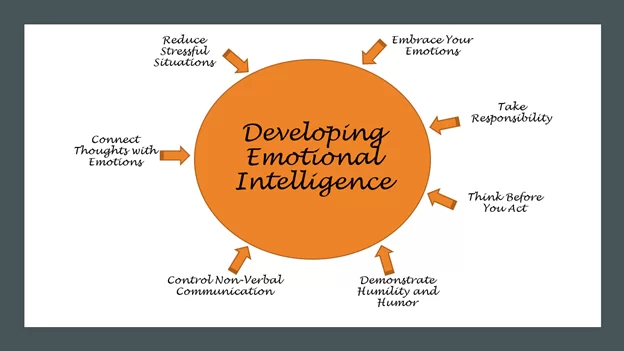
Emotional Intelligence (EI) is the ability to sense, understand, and effectively personal emotions and the emotions of those around you to get the best of human energy, information, trust, creativity, and influence. EI can deliver the following benefits: Embrace your emotions Take responsibility Think before you act Demonstrate humility and humor Control non-verbal communication Connect thoughts with emotions Reduce stressful situations EI is useful for career success, helping leaders and their staffs build a collaborative culture, emphasize everyone’s strengths, and work to mitigate weaknesses. EI is a method that can create strong bonds in teams by sharing technical expertise and creating solid recommendations for action. There are key components to EI in the workplace: self-awareness, self-regulation, social awareness or skill, empathy, and motivation. Self-awareness is the ability to know your emotions, strengths, weaknesses, and motivators and how they affect others. Self-regulation is the ability to manage personal emotional state and to think before acting. Social awareness or skill refers to proficiency in managing relationships, finding common ground, and building rapport. Empathy is about understanding and appreciate other people’s emotions, strengths, weaknesses, and motivators and use the knowledge to guide your behavior. Motivation is the passion and persistence that guides your efforts in reaching team goals. Two theories are helpful for those who embrace EI. Sensemaking Theory is a collaborative process that creates shared awareness and understanding out of different individuals’ perspectives and varied interests. Communication Accommodation Theory addresses adjusting verbal and nonverbal interactions to emphasize or minimize differences between participants. These interactions use language, context, identity, and intergroup and interpersonal factors to find common ground. There are many benefits to developing EI in the workplace beyond those listed here. I look forward to continuing the discovery.
Right Fit Leading: EI in the Workplace Read More »