Social Media

Saluting African American Leaders

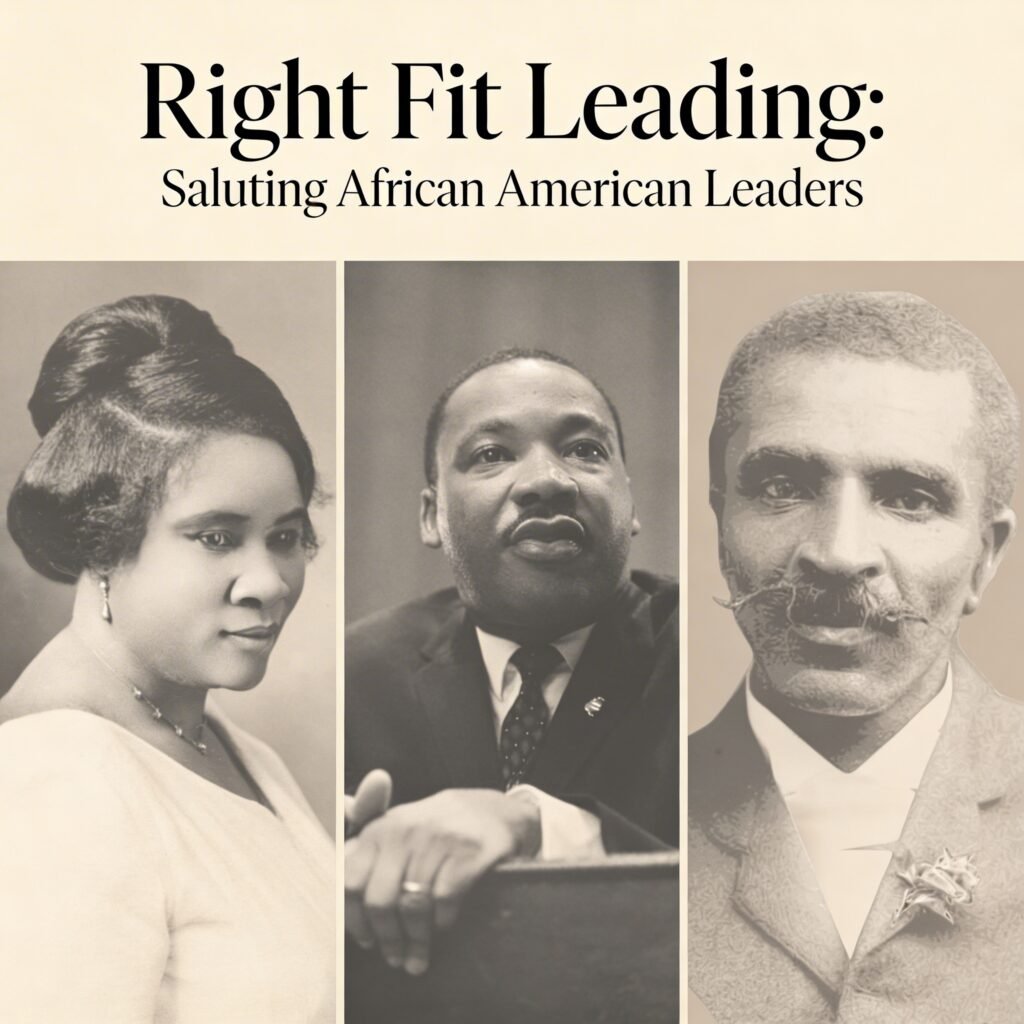
Right Fit Leading: Saluting African American Leaders

In honor of Black History Month, we want to highlight a few leaders from the National Archives and other sources. Please feel free to think about some of the countless others we can emulate. Our voice is more important than ever. Stay curious, find the data, and share informed messages using your voice. Martin Luther King, Jr. (January 15, 1929 – April 4, 1968) Image by WikiImages from Pixabay Dr. Martin Luther King, Jr. was one of the most important and influential Civil Rights leaders in the 1950s and 1960s. The cornerstones of his activism were based on non-violence and civil disobedience, both of which were inspired by his Christian faith and the teachings of Mahatma Gandhi. His words live on today. Madam C.J. Walker (1867-1919) https://www.history.com/articles/madame-c-j-walker Creating a line of hair products geared toward Black hair propelled Madam C.J. Walker to be the first African American woman to be a self-mad millionaire. According to Oprah Daily, “rst African American woman to become a self-made millionaire after creating a line of hair She created the first, Madam Walker’s Wonderful Hair Grower, in 1905. A Netflix series based upon her life, Self Made, premiered in March 2020.” George Washington Carver (1864-1943) Image by OpenClipart-Vectors  from Pixabay George Washington Carver was an agricultural chemist who wanted to increase the profitability of peanuts and sweet potatoes. His experiments in 1896 (revealed in 1914) led to 518 new products from the crops, including ink, dye, soap, cosmetics, flour, vinegar, and synthetic rubber. He is also known for giving us peanut butter. There are others, Barack and Michelle Obama, Kamala Harris, Shirley Chisholm, Gen. Benjamin O. Davis, Malcolm X, Stevie Wonder, Jesse Owens and others too numerous to mention. There are countless others who created our past, present, and future. Salute them all! Honor them all!  #BlackHistoryMonth

Right Fit Leading: Saluting African American Leaders Read More »

the power of strategic communication

The Power of Strategic Communication in Organizational Success: Achieving Clear Messaging and Shared Understanding

Let us talk about strategic communication. This is about delivering the right message, through the right channels, and evaluating outcomes against organizational goals and objectives. Whether you partner with a Richmond public relations agency, a Virginia public relations firm, or any other communication specialist, the core purpose remains the same: clarity, alignment, and impact.The Department of Defense (DOD) Principles of Information define this practice as making available timely and accurate information to allow the public, Congress, and the news media to assess and understand the facts about national security and defense strategy (DOD Directive 5122.5, Change 1). The strategy of communication manages how to develop goals and that will influence various audiences and stakeholders to achieve state objectives. Professionals dedicated to this approach integrate theory, real-world practice, and skills training while examining communication through various skills and specialties: public relations, crisis communications, marketing, persuasion theory, advertising, and communication campaigns. This same integrated approach is used by many strategic communications agency Richmond businesses to help organizations achieve measurable results.Strategic communicators identify and address challenges and opportunities. One view of addressing challenges comes from James Goodwin in Returning to Interpersonal Dialogue and Understanding Human Communication in the Digital Age. Interpersonal deception, issue acceptance, privacy and control of information, and relationship building are key challenges people face each day in their quest to communicate effectively. Conquering these challenges is important in achieving shared understanding in an interaction that flows smoothly and has feedback and adjustments in communication. These principles are core elements of work commonly handled by a media relations agency Richmond VA that focuses on crafting accurate, engaging, and trustworthy messages.Communicators must deal with key challenges that will allow successful interactions. It is good to start with dealing with interpersonal issues to enhance communication because participants may flourish or struggle with interpersonal control and may use interpersonal deception. Interpersonal control is a strategy that determines how the sender controls the receiver or how one person in an interaction controls the other. Sender and receiver roles change during communication activities and interpersonal control is a way of managing or regulating another’s thoughts, feelings, or actions (Stets 1991). When we address how people manage actual or perceived deception in face-to-face interactions, we are dealing with interpersonal deception.Interpersonal deception can occur consciously or subconsciously. Interpersonal Deception Theory states that senders try to manipulate messages to be untruthful, causing apprehension on the part of the sender due to the concern that someone may discover their false communication. At the same time, receivers try to determine the validity of the information, creating suspicion about whether the sender is being deceitful (Brown 2017). Deceptive messages have three parts: Communication done right builds social capital and lasting relationships. It allows leaders to be flexible and enables them to send the right message on the right platform at the right time.“Most importantly, carefully assess the people you share with, and then assess them again. In your social networking activities, you might use a ‘friend of a friend’ system for vetting people. If they know a member of your network that you trust and respect, then maybe you can accept connecting with them. Without that, it might not be wise to accept someone you have not met. Having said all of that, you might want to take some risks. There are just too many people involved in the social networking adventure who are too compelling to ignore, delete, refuse, or turn away from. Once the adventure has captured your full attention, push forward with privacy controls (Brown and Schario 2014).”The key to successful strategic communications is building a solid plan. A framework below. Effective strategic communications allow leaders to achieve shared understanding and consistency in operations, ensure team members understand and achieve buy-in, and enhance productivity because everyone’s effort flows in the same direction.

The Power of Strategic Communication in Organizational Success: Achieving Clear Messaging and Shared Understanding Read More »

Call for Chapter Proposals: Interpersonal Dialogue and Human Communication

  CALL FOR CHAPTER PROPOSALS Returning to Interpersonal Dialogue and Understanding Human Communication in the Digital Age A book edited by Michael A. Brown Sr, PhD, Florida International University, and Leigh Nanney Hersey, Ph.D., University of Louisiana at Monroe     Introduction Human communication is struggling in what is a global crisis.  Society no longer fosters face-to-face interactions.  Compounded by the influence of the digital world, digitally-driven interactions in a multi-generation society have resulted in personal interactions that are fraught with limited feedback, erroneous and incomplete information leading to misunderstandings, even confrontations.  Digital collaborations are abundant, but can be problematic as an incomplete solution to the human need for comprehensive communication.  The 5,000 digital messages the average American receives daily lack full-process interactions from sender to receiver to feedback (see note). This creates communication based on missing information, gaps in communication, misinterpretation of language and other barriers.  Human communication distinguishes face-to-face communication as a priority over online or digital interactions.  This is not to downplay the electronic arena; just to highlight the connection between people that involves the five senses. High-touch, effective communication is about using social capital to build relationships and make information-sharing connections.  It is important to improve internal and external digital communications and to demonstrate ways to “positively affect productivity, levels of trust, and the ability to conduct bonding, bridging, and linking activities.”  High-touch activities lead to engagingly effective communication relationships with valuable feedback.  The book would address face-to-face interactions and digital collaboration, possibly in separate sections. NOTE: Sheree Johnson, New Research Sheds Light on Daily Ad Exposures, Sept. 29, 2014, https://sjinsights.net/2014/09/29/new-research-sheds-light-on-daily-ad-exposures/ .   Objective of the Book Dr. Brown’s previous work in Solutions for High-Touch Communication in a High-Tech World (IGI Global, March 2017) sets the stage for a full examination of human communication in today’s society by comparing online and face-to-face interactions.  This book takes advantage of that foundation and develops solutions for success in academia and in business by analyzing various types of face-to-face and digital interactions in terms of comprehension and relationship-building.  The integration of techniques for all human communication gives people resources to be successful collaborators in contemporary society.  This is an approach you won’t find in any one book today.   Recommended topics include, but are not limited to, the following: A global communication crisis?  Real or imagined? Data Gathering Relevant to the Challenge Unmediated and Mediated Interactions Face-to-Face Interactions Digital Collaboration Integrated Communication Focus on the Non-Digital Aspects of Communication in Society Communication: Interaction, Collaboration or Both? Communication, Evaluation and Comprehension Health and Communication Choosing the Right Platform for Communicating Developing relationships – face-to-face and online Making Communication Human – full-process communication with feedback Historical development of face-to-face vs online communication New research directions in human communication Evaluating social media communication Evaluating social media trust Comparing face-to-face and online communication methods, strengths, weaknesses Interactive communication Evaluating quantity vs quality in communication Trust and communication Trust and privacy Inter-organizational communication   Submission Procedure Researchers and practitioners are invited to submit on or before April 1, 2017, a chapter proposal of 1,000 to 2,000 words clearly explaining the mission and concerns of his or her proposed chapter. Submit your proposal at http://www.igi-global.com/publish/call-for-papers/call-details/2660. Authors will be notified by June 1, 2017 about the status of their proposals and sent chapter guidelines. Full chapters are expected to be submitted by August 1, 2017, and all interested authors must consult the guidelines for manuscript submissions at http://www.igi-global.com/publish/contributor-resources/before-you-write/ prior to submission. All submitted chapters will be reviewed on a double-blind review basis. Contributors may also be requested to serve as reviewers for this project. Note: There are no submission or acceptance fees for manuscripts submitted to this book publication, Returning to Interpersonal Dialogue and Understanding Human Communication in the Digital Age. All manuscripts are accepted based on a double-blind peer review editorial process. All proposals should be submitted through the E-Editorial DiscoveryTM online submission manager. Publisher This book is scheduled to be published by IGI Global (formerly Idea Group Inc.), an international academic publisher of the “Information Science Reference” (formerly Idea Group Reference), “Medical Information Science Reference,” “Business Science Reference,” and “Engineering Science Reference” imprints. IGI Global specializes in publishing reference books, scholarly journals, and electronic databases featuring academic research on a variety of innovative topic areas including, but not limited to, education, social science, medicine and healthcare, business and management, information science and technology, engineering, public administration, library and information science, media and communication studies, and environmental science. For additional information regarding the publisher, please visit www.igi-global.com. This publication is anticipated to be released in 2017. Important Dates April 1, 2017: Proposal Submission Deadline June 1, 2017: Notification of Acceptance August 1, 2017: Full Chapter Submission September 30, 2017: Review Results Returned November 15, 2017: Final Acceptance Notification November 30, 2017: Final Chapter Submission Inquiries can be forwarded to Michael A. Brown Sr, PhD Florida International University dr.michael.brown76@gmail.com (757) 876-6589 Leigh Nanney Hersey, PhD University of Louisiana at Monroe Hersey@ulm.edu (318) 342-1332  

Call for Chapter Proposals: Interpersonal Dialogue and Human Communication Read More »

Call for Chapters: Social Media Performance Evaluation and Success Measurements

As many organizations work to create social media policies that improve online interactions and provide security protections, performance is neglected.  Organizations do not tend to inquire about return on investment or performance implications until they are well into social networking activities.  This book demonstrates that using measurement tools facilitates success in social networking activities and in policy decisions.  This is important because it gives organizations tools with which they can impact online interactions as they happen.  Effective measurement can also suggest methods to affect behaviors that support the organization’s goals and objectives.  There are two major objectives.  First, help organizations identify social networking participation expectations, value and return on investment of time.  Second, highlight the true value of social networking, focusing on public administration to evaluate social networking and individual performance differences in participation, behavior, technology acceptance, and trust.  This is a new approach to social networking.  Issues in evaluating trust in social media, examining social networking participation in a different way, and addressing digital communication return on investment, all point to the need for an edited collection of original research in this area. This project is intended to provide researchers and academicians a new source for social networking methodology.  The scored survey instrument, research findings and relevant discussions from industry experts will be helpful in teaching and training applications.  The body of work focuses on the end state of social networking activities rather than the social media platform, an important distinction.  The basis of the book is a published dissertation by Dr. Michael A. Brown Sr.  SNIP doesn’t focus on “how to” use platforms, it’s about deciding on an end state and devising a strategic approach to arrive at that destination.  The focus is on expectation, value and return on investment of time in social networking, and the author believes there is no reference that focuses on that approach. The target audience of this book will be composed of professionals and researchers working in the various fields of public administration, and can be used to reinforce organizational training and improve internal and external communications. This work directly relates to the information and business fields in terms of communication; however, social networking and social media continue to grow in medical and engineering science, making the book relevant there as well. Further, there are implications for information and knowledge management in various disciplines, e.g. library, information and communication sciences, administrative sciences and management, education, adult education, sociology, computer science, and information technology. Recommended topics include, but are not limited to, the following: Social media/social networking historical development Social networking theoretical implications New research directions in social media/social networking What is social networking engagement: day-to-day issues What is social networking engagement: crisis communication applications What is social networking engagement: attacks on brand identity Evaluating social networking participation Information acquisition and sharing Interactive communication Finding social networking success – case study/research Finding support for social networking participation – personal or organizational Evaluating quantity vs quality in social networking Trust in social networking Privacy in social networking Trust model Trust as capital Inter-organizational communication Interpersonal trust Trust building Cognitive trust and affective distrust Submission Procedure Researchers and practitioners are invited to submit on or before Friday, January 22, 2015, a chapter proposal of 1,000 to 2,000 words clearly explaining the mission and concerns of his or her proposed chapter. Authors will be notified by January 30, 2016 about the status of their proposals and sent chapter guidelines. Full chapters are expected to be submitted by April 30, 2016, and all interested authors must consult the guidelines for manuscript submissions at http://www.igi-global.com/publish/contributor-resources/before-you-write/ prior to submission. All submitted chapters will be reviewed on a double-blind review basis. Contributors may also be requested to serve as reviewers for this project. Note: There are no submission or acceptance fees for manuscripts submitted to this book publication, Social Media Performance Evaluation and Success Measurements. All manuscripts are accepted based on a double-blind peer review editorial process. All proposals should be submitted through the E-Editorial DiscoveryTM online submission manager. This book is scheduled to be published by IGI Global (formerly Idea Group Inc.), an international academic publisher of the “Information Science Reference” (formerly Idea Group Reference), “Medical Information Science Reference,” “Business Science Reference,” and “Engineering Science Reference” imprints. IGI Global specializes in publishing reference books, scholarly journals, and electronic databases featuring academic research on a variety of innovative topic areas including, but not limited to, education, social science, medicine and healthcare, business and management, information science and technology, engineering, public administration, library and information science, media and communication studies, and environmental science. For additional information regarding the publisher, please visit www.igi-global.com. This publication is anticipated to be released in 2016. Important Dates Feb 5, 2016: Proposal Submission Deadline TBD: Notification of Acceptance April 30, 2016: Full Chapter Submission June 30, 2015: Review Results Returned August 15, 2016: Final Acceptance Notification August 30, 2016: Final Chapter Submission Inquiries can be forwarded to Dr. Michael A. Brown Sr, PhD dr.michael.brown76@gmail.com (757) 876-6589

Call for Chapters: Social Media Performance Evaluation and Success Measurements Read More »

0