

Please come by and see 3 of the books in our collection.
Please come by and see 3 of the books in our collection. Read More »

Understanding the signs of emotional intelligence (also known as EQ) is beneficial for many reasons. It can help leaders determine strengths in others. It may also serve to identify where they might improve to achieve a higher level of emotional intelligence. Having a full awareness of the topic is a great place to start in reaching new heights. What is Emotional Intelligence? Emotional intelligence is defined as “the ability to recognize, understand, and deal skillfully with one’s own emotions and the emotions of others.” Those with high levels of this quality are known to have improved relationships, reduced stress, and optimized decision-making. The following signs of emotional intelligence indicate the level at which your emotional quotient sits. 1. Attuned to the emotions of others. Awareness of how others are feeling based on their tone, body language, and simply listening to what’s being said is crucial to EQ. When tone and body language send a different message than the words expressed and the listener picks up on it, high levels of EQ are present. 2. Willing to lose an argument. For many people, losing an argument feels incredibly difficult and is to be avoided at all costs. However, an individual with obvious signs of emotional intelligence is someone who accepts loss. Losing an argument is not an event that ruins their day; rather, it is a learning opportunity. 3. Self-aware of personal feelings. It may be surprising to learn that not all people have a grasp on their own feelings. In many cases, human beings mistake one feeling for another. When a person is fully aware of their feelings and can easily name them, they are considered to have signs of emotional intelligence. 4. Accountability for mistakes. Admitting when mistakes are made matters in the world of EQ. Someone with a high level does not avoid the responsibility of claiming errors. Instead, they hold themselves accountable by announcing the mistake when necessary and working to fix it. 5. Self-motivated to pursue a purpose. Motivation is often fleeting, but a sure sign of high emotional quotient is an individual who has goals and strives to reach them. This individual has a clear vision for their future. 6. Stress is well managed. Research shows that those with a high emotional quotient are capable of handling stress better than those with a low EQ. You won’t find them overly anxious over decisions or life’s happenings. 7. Differing opinions can be shared respectfully and openly. When someone is unable to listen to opinions that differ from their own, it can be a problem. An open mind and ability to listen to others’ ideas shows respect and EQ. It also shows the ability to think through varying opinions. 8. Always kind, even when it is undeserved. Kindness is not always easy for everyone. In fact, those who can demonstrate kindness when kindness is not shown in return are likely to have a high emotional quotient. If a person loses their patience or snaps, the individual with a high EQ can remain calm and continue to be kind. 9. Self-control is a high priority. The ability to control one’s actions and reactions is vital to emotional intelligence. This is true in all circumstances. Of course, perfection is impossible, but the ability to control responses and remain disciplined demonstrates a strong emotional quotient. 10. Actively acknowledge gratitude. Gratitude is not simply a practice for improved mental health, although it does help. Expressing gratitude, or at the very least, acknowledging it, is one of the signs of emotional intelligence. 11. Feedback is welcome and well received. For many, feedback is difficult to hear. Many feel attacked or ashamed to require commentary on their efforts. With that said, when an individual openly welcomes comments on their work, it is a benefit. 12. Exhibits strong social skills. Research shows that social skills became less common as a result of the pandemic. However, these skills are still present in many individuals, particularly those with a high emotional quotient. 13. Actively seek to help others. One of the most common signs of emotional intelligence is empathy and the desire to help other people. When someone seeks out opportunities to help people, they are showing signs of high EQ. Why Should I Know Signs of Emotional Intelligence? Comprehending the signs of emotional intelligence can be beneficial in numerous ways. It can make hiring decisions easier, as many employers would rather hire an individual with a high emotional quotient. These signs may also introduce goals to strive for personal development and improved communication. Using the signs as a tool can be beneficial to anyone on a journey of development and growth. Conclusion Whether you seek to fully grasp the signs of emotional intelligence for communication, leadership, personal development, or any other area, Right Fit Communications, LLC can enhance growth. Schedule a consultation today!
13 Signs of Emotional Intelligence Read More »

Here’s a truth that may be hard to swallow: your bad communication habits can have a hugely negative effect on your work. In fact, a recent study showed that, on average, large organizations lost $62.4 million annually as a result of poor communication. Even if your organization is smaller, losses occur due to communication errors. Discovering which bad habits you and your team have developed may be more enlightening than you imagined. 1. Interrupting Interrupting is a bad communication habit that some don’t even realize they do. However, it is something that can have an overall negative effect on teams and businesses. According to a 2011 publication, interrupting can result in poor task completion time, more errors, complications with the decision making process, and more. If you interrupt without realizing it, it’s likely because your focus is on what you will say more than on listening. Or, maybe you worry that you’ll forget what you want to say before it’s your turn to talk. No matter the reason, make an effort to skip the interruption. 2. Aiming to Sound Intelligent Many people want to sound smart, but this makes for a difficult conversational exchange. When language is anything other than straightforward, there will be miscommunications. Jargon and fancy words might sound interesting to you, but it can confuse others. Leave buzzwords and overly technical language behind. Keep your language simple and conversations will flow more smoothly. Bad communication habits like this one can do far more harm than good. 3. Fast Talking Although you may have a lot to say and want to get it all out, fast talking isn’t going to help anyone. Nor is rambling, which can be much in the same vein. Take a breath and figure out the point of what you need to say before you say more than you need to. Slowing down the tempo can also help others to grasp what is being said as you say it. The human brain requires time to process information; be sure to allow it. 4. A Lack of Listening Have you ever been chatting with someone and they said something you’d already mentioned? Or, maybe they asked a question that you’d answered two sentences ago? It can be hard to carry on a conversation when the other person isn’t listening well. Now, flip it around and consider how well you listen. Do you ever spend your time in conversation considering what story you’ll tell? If you are, you’re not listening. Take in what your conversation partner is saying – this can even help the company culture thrive! 5. No Awareness of Body Language A bad communication habit is a lack of knowledge of what body language projects. This can be true as an individual giving off body language and also seeing it in others. When you are speaking and your arms are crossed, you could be signaling to others that you’re feeling defensive. In truth, you could be cold, but it is important to consider what they may pick up from your body language. Alternatively, if you are speaking with someone and they are angled away from you, it can be a signal that they are not interested in the conversation. Excusing them from the conversation may be necessary, or changing communication tactics may help as well. 6. Over-apologizing and lacking confidence When you start a conversation with an apology that isn’t necessary, you give the impression that you lack confidence in the topic. For example, when you say, “Sorry, can I maybe share an idea?” You give the impression that you aren’t allowed to speak and that you don’t feel great about the idea. This is true of the “sorry” and the “maybe.” These words lack confidence, which is one of many bad communication habits worth ditching. Use language that encourages others to listen to what you have to say. 7. Like, Um, So Bad communication habits include filling your sentences with filler words that aren’t needed, such as “like,” “um,” “so,” and “now.” Although it can be difficult to break this habit, it is also one that pays off in the long run. Using filler words can be incredibly distracting. It also pulls away from the primary message of the communication. It is always best to erase the unnecessary from speech. Bad Communication Habits Conclusion Although there are many bad communication habits to break, these seven offer a starting point. Whether you are someone who interrupts or unintentionally adds unnecessary words, breaking the bad habit will take some effort. If you require assistance in determining or breaking your bad communication habits, Right Fit Communications, LLC can be of great benefit to you. Furthermore, if your team requires extra communication assistance, please reach out to determine how Right Fit Communications, LLC can help.
7 Bad Communication Habits to Kick to the Curb Read More »

Poor time management is a problem in many organizations and personal lives. In fact, if time were managed better, many organizations would see more than an increase in productivity. People would see improvement in their home lives. There would be more space for work-life balance and effective breaks throughout the day. By examining all of the mistakes employees make in their management of time, it is easier to make changes to enhance performance and effectiveness. What is Poor Time Management? Many people feel as though there are not enough hours in a day. In truth, this is a sign that you’re either a) too busy or b) have poor time management skills. Fortunately, both of these things are fixable with some improved habits. Habits are a major component of managing time because they are often what fill your time, whether they are good or bad. For instance, scrolling social media for three hours is a bad habit resulting in poor workload management. Taking control of bad habits can improve how you manage your time. What Causes Poor Time Management? While distractions like social media result in poor time management, they may not be the primary cause. According to science, the human brain is designed to cycle attention, which is critical to survival. It allows humans to be aware of their surroundings while focused on a task, like keeping an eye on children and being aware of street traffic simultaneously. However, the modern world offers more stimulation than ever before, thus resulting in more challenges in managing time. Over the years, the human attention span has gotten shorter and shorter. In 2012, it was estimated to be about 75 seconds. Within the last several years, that time has shrunk to 47 seconds. Fixing the problem may begin with a complete grasp of why it needs fixing. Why Do I Need to Fix Poor Time Management? If it’s the brain’s natural cycle, why do humans require improvement in this area? Although distractions are many, it is not necessary to always give in to them. If we allow distractions to rule, productivity tanks. Fortunately, there are numerous strategies for improving how you use your time. Finding a strategy that works for you is vital to beating the issues at hand. Strategies to Avoid Poor Time Management Many methods for improving your time management have been proven to work. Choosing the right strategy is based on personal preference and habits. 1. Pomodoro Technique The Pomodoro Technique is a popular strategy for remaining focused for a short time and then taking a short break. Set a timer for 25 minutes and focus on a single task until time is up. Then, take a five-minute break. Working in this way allows the mind to focus and rest at an interval. 2. Time Blocking Time blocking is a scheduling method that only requires one tool: a calendar. By grouping like tasks together into chunks and assigning them a block of time, you can be more productive. Consider using 30-minute to an hour chunks to get started. 3. Pickle Jar This method requires imagining filling a jar with rocks, pebbles, and sand. The sand represents the little distractions throughout the day, the pebbles are tasks that need to get done but are not a priority, and the rocks are the vital tasks that need to be completed. By organizing your task list with the rocks at the top, then the pebbles, and then the sand, you can ensure the most important items get checked off first. 4. Eat that Frog The Eat That Frog method sounds odd, but it does make sense. By tackling the hardest task first, the rest of the day will go more easily. Eat That Frog begins with listing all tasks and identifying the one you least want to do. Every other task will feel simple after completing something truly challenging. 5. Eisenhower Matrix Finally, the Eisenhower Matrix is a strategy meant to define each task and its priority using four categories: do, decide, delegate, and delete. Categorize “do” items as the most urgent tasks, “decide” as those that have importance but no urgency, “delegate” as those that are lacking importance but have urgency and can be passed to someone else, and “delete” should be reserved for the tasks that have no importance and no urgency. Conclusion Defeating the beast that is poor time management doesn’t have to be an overwhelming task on top of all the others. In fact, by simply leaning into the options available in the world of task management, it is possible to tackle more items on your to-do list. Even better, you don’t have to do it alone. If you need a little extra help, Right Fit Communications LLC is ready to give you the boost you need.
5 Methods to Avoid Poor Time Management Read More »

There comes a time in many leaders’ careers when wondering how to build an effective team plagues the mind. For many, team building is complicated and seemingly impossible. Research shows that approximately a quarter of the value added to a team comes from less than 5% of the employees. Increasing team effectiveness could make a genuine impact on the business as a whole. While building an effective team is not easy, it can be made simpler by implementing five simple steps. Step 1: How to Build an Effective Team with Proper Hiring When hiring new employees, leaders often look for specific qualities in candidates to fill the role. However, many miss a critical aspect: hiring to round out the team. Hiring should be embraced as a way to contribute to the team, not solely to the role. In the same vein, hiring is not the only way to build a team. Hiring and building on current employees’ skills should both be considered important. Additionally, hiring should be considered a group activity. Traditionally, a candidate has an interview with a leader, is hired, and then inserted into the team. Involving the team in the hiring process can make it easier to build an effective team. Consider having a team member in the interview, introducing candidates to the team before making hiring decisions, and getting feedback from existing members. Step 2: Focus on Open, Clear, and Transparent Communication One of the biggest components of an effective team is fantastic communication. Team members must have access to leadership and other departments to share information, provide feedback, and ask questions. Leadership should be able to mediate when necessary without taking sides. Doing so can effectively build trust, a crucial aspect of effective teams. Trust is also built on transparency. When communication is used to bury truths or side-step details, it becomes more harmful than beneficial. Encouraging transparent communication among team members and leaders will help to establish a firm level of trust. If you truly want to know how to build an effective team, you must think about how you share messages. Communication should also be clear and direct. When messages or statements lack focus, use complicated jargon, or present too much information at once, clarity is lost. The team’s goals, vision, and roles must be made completely clear to all on the team. Step 3: Value Each Team Member Equally Often, the highest performer is the most valued member of a team, and everyone in the office knows it. While it is good to have a high performer, it can be alienating to focus all energy on a single player. Every employee has value and should be treated as such. This begins by valuing the opinions and feelings of each person. It also requires identifying the team’s strengths and gaps. Recognizing the strengths a team member has will allow the team to appreciate their contribution. Another aspect to include in valuing team members is to spend quality time together. It can be difficult to develop an effective team if everyone on the team is a stranger. Team building should not stop at first introductions or occasional awkward activities. Continuous growth is always necessary to be the most effective, and team building is a big component of that. Never stop building. Lastly, if you want to know how to build an effective team, value and encourage each person’s creativity and individualism. A team filled with carbon copies of one another is not much of a team. Diversity, on the other hand, allows for new levels of innovation and better business results. Encouraging creative thinking and individuals’ ideas introduces a whole new light to the work at hand. Step 4: How to Build an Effective Team with Empowerment When a leader empowers team members to accomplish tasks to the best of their abilities, there is a certain level of trust involved. Yes, a team member might make a mistake. However, far more benefits come from extending that trust to each team member. Restricting abilities only results in more work for someone else. Granting individuals the power to take risks shows that they are trusted. Plus, those risks can become positive gains. Step 5: Encourage Cooperation Over Competition A 2024 study suggested that cooperation and competition offer similar results in business success. However, a major difference lies in employee well-being. A competitive environment increases stress and the physiological burden. Alternatively, a cooperative environment improves performance without the added stress. Conclusion Learning how to build an effective team begins with knowledge. However, it cannot stop at reading a “how to build an effective team” article. To actually build that team, you must take action. Contact Right Fit Communications to set up a consultation and determine what comes next.
How to Build an Effective Team in 5 Steps Read More »
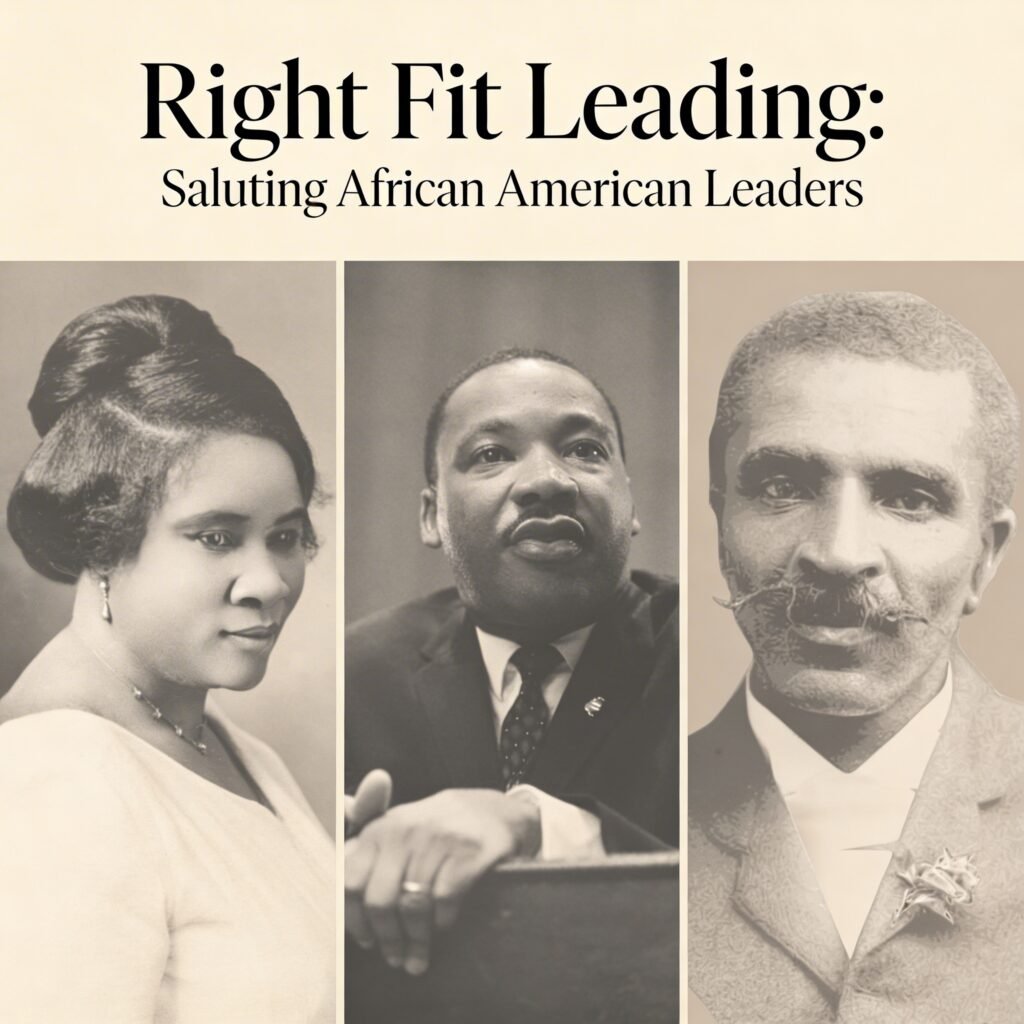
In honor of Black History Month, we want to highlight a few leaders from the National Archives and other sources. Please feel free to think about some of the countless others we can emulate. Our voice is more important than ever. Stay curious, find the data, and share informed messages using your voice. Martin Luther King, Jr. (January 15, 1929 – April 4, 1968) Image by WikiImages from Pixabay Dr. Martin Luther King, Jr. was one of the most important and influential Civil Rights leaders in the 1950s and 1960s. The cornerstones of his activism were based on non-violence and civil disobedience, both of which were inspired by his Christian faith and the teachings of Mahatma Gandhi. His words live on today. Madam C.J. Walker (1867-1919) https://www.history.com/articles/madame-c-j-walker Creating a line of hair products geared toward Black hair propelled Madam C.J. Walker to be the first African American woman to be a self-mad millionaire. According to Oprah Daily, “rst African American woman to become a self-made millionaire after creating a line of hair She created the first, Madam Walker’s Wonderful Hair Grower, in 1905. A Netflix series based upon her life, Self Made, premiered in March 2020.” George Washington Carver (1864-1943) Image by OpenClipart-Vectors from Pixabay George Washington Carver was an agricultural chemist who wanted to increase the profitability of peanuts and sweet potatoes. His experiments in 1896 (revealed in 1914) led to 518 new products from the crops, including ink, dye, soap, cosmetics, flour, vinegar, and synthetic rubber. He is also known for giving us peanut butter. There are others, Barack and Michelle Obama, Kamala Harris, Shirley Chisholm, Gen. Benjamin O. Davis, Malcolm X, Stevie Wonder, Jesse Owens and others too numerous to mention. There are countless others who created our past, present, and future. Salute them all! Honor them all! #BlackHistoryMonth
Right Fit Leading: Saluting African American Leaders Read More »